Friday, 5 June 2020

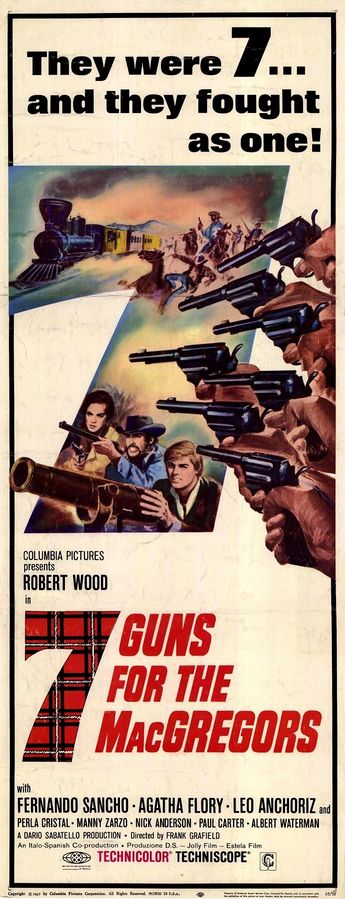
7 Guns for the MacGregors

Dir: Franco Giraldi 


1966 


In a pre-Trinity Spaghetti Western world comedies were a lot less common. They still existed (the Franco and Ciccio films are obvious examples) but, more often than not, filmmakers who wanted to veer away from the prevailing Leone-esque model just chose to approach the genre with a lighter tone; mixing action/adventure elements with comedic moments. 7 Guns for the MacGregors is a perfect example of this approach and highlights the positives and negatives inherent in the choice. It's also a good example of how, even with light-hearted intentions, Italian filmmakers of the day just couldn't help but drift into darker territory when telling a western story. 

In this largely family friendly romp we have six MacGregor brothers (the seventh is wounded early on and left at home) setting off to sell the family horse herd for maximum return in the town of Las Mesas. On arrival they find a town run by a Mexican bandit who, through his hired officers, steal the livestock and throw the boys in jail. This doesn't sit well with the feisty MacGregors and it isn't long before they have broken out and set upon a scheme to hit the bad guys where it hurts through a process of infiltration and preemptive robberies. 

The first thing that struck me when watching 7 Guns for the MacGregors was that it obviously enjoyed a decent budget in comparison to many other Spaghetti Westerns. It has a big cast, the action sequences are on a pretty grand scale and there's a train in it; a dead giveaway when judging whether a film of this type had any money behind it. The second thing that struck was that most of that money seemed to be funnelled into those grand action sequences and that is not a bad thing when you are making an action/adventure film. In movies like this the story and script are of limited importance and a well staged mass attack on a moving train can divert attention away from a lot of other weaknesses. Character study is light here to say the least but who cares once the town water tower gets blown up. Dialogue a bit clunky? What the hell, there's 20 bandits on horseback chasing a train! 

What I learned subsequent to my first viewing of the film over a decade ago is that, whatever the budget, corners were cut in terms of safety and as a result a number of the cast suffered some substantial injuries and one legend of the genre came within inches of losing his life. During the shooting of the train robbery Fernando Sancho, playing Miguel one of the bandit lieutenants, climbs on top of the moving train and stands up just as it passes over an iron bridge. The bridge has girders fixed above and Sancho's head comes within a whisker of colliding with the first one as he stands up. Watching him duck suddenly just before impact is a hairy moment to watch but clearly no thought was given to cutting it out and you can't blame Sancho if he didn't fancy re-shooting it. In fairness, it does add a sense of real danger to an already exciting sequence. It brings to mind a similar incident in The Good, the Bad and the Ugly when a train footplate almost takes Eli Wallach's head off as he is crouching by the trackside. The fact that stuntmen weren't used in either of these scenes beggars belief today. The absence of a suitably sized stuntman, along with poor health and safety practice, also led to lead actor Robert Woods sustaining a bad back injury during the film's gripping finale fight scene on a water wheel. With no stand-in of the right size (Woods is six foot five) the star was forced to do most of his own stunts and poor communication led the wheel to be unexpectedly stopped suddenly, sending Woods flying onto his back. To his credit the American actor carried on and the only clue to his painful condition is when he fails in another scene to successfully leap over a horse's rump and into the saddle in one go. He lands halfway and just about hangs on but the director thought it looked more realistic and duly kept it in anyway. 

Not that there was a lack of stuntmen in general on the set. Most of the MacGregor brothers were stuntmen turned actors including Roberto Dell'Aqua, Nazareno Zamperla and Paolo Magalotti. This is not a bad thing in a film so big on action and results in a high level of physicality well executed. This is one of the film's strengths but there are more. To begin with the cast is strong. Robert Woods suits the role of smiling hero Gregor MacGregor well, Leo Anchoriz and Fernando Sancho are always good value in Mexican bandit roles and the bevy of other familiar faces include George Rigaud, Victor Israel, Cris Huerta and Antonio Molino Rojo. Perla Cristal and Agata Flori add some glamour and the score from Morricone includes a good rousing anthemic theme as well as a slightly less pleasing pseudo Scottish bit. This is a light-hearted action/adventure picture pure and simple and it delivers on those terms pretty well. The water wheel fight scene is a standout and will stick in the memory. The large scale action sequences are well executed and the comedy never quite crosses the line into pastiche which is always a blessing. 

But it also flirts with a dark side. In particular, there is a scene quite early on where a former ally of the bandit leader is brutally executed with fire for the entertainment of the gang. There is nothing too graphic in a Fulci kind of way but the very fact that someone is repeatedly dragged through a fire and seen engulfed in flames seems a little strong in a film which would otherwise be straightforward family fare. It's a good scene. I'm just not sure it fits here. This is certainly not a facet unique to this film. I've seen it elsewhere in the genre and often wondered what the thinking was behind it. Were they adding grit to keep the young adult male audience happy at the time? Or did they just not see it as anything over the top for any Italian audience? Kids or otherwise. Maybe they just couldn't help themselves.

What can be said for sure is that director Franco Giraldi showed a repeated tendency for this in his westerns. He made four westerns in three years of which this was the first and three out of the four balanced on the same line to various degrees. This film and its sequel, 7 Women for the MacGregors followed similar lines while the film he made in between, Sugar Colt, is possibly the most extreme case; jumping at once from dead serious to slapstick comedy. Only his fourth western, A Minute to Pray, a Second to Die is a straight forward drama without comedic elements. In fairness to Giraldi, for the most part, he pulls this balance off successfully in all of them to one degree or another and is never short of entertaining. 

Is this a Spaghetti Western I would recommend then? Certainly. As long as you are not looking for something in the gritty heavyweight line this film has plenty to enjoy. There are a couple of standout scenes and plenty of action and sometimes that is all you need when sitting down to watch an escapist film. It was certainly successful enough in its time to sire a sequel and was in fact the biggest grossing film Robert Woods had during his time in Europe so it obviously hit the right spot with its contemporary audience. 

Just leave your cynical hat behind and Up the MacGregors!

I watched this film on an Italian DVD release from Ripley Home Video.  Picture quality is pretty good and both Italian and English audio tracks are offered but no subtitles unfortunately.  The English dub slips out of sync for a period early in the film but rights itself before too long.  This is a fault on all copies of this release as far as I'm aware and, at time of writing, is the only English friendly DVD release of the film globally.

Wednesday, 3 June 2020

The Specialists


Dir: Sergio Corbucci


1969


Famed gunman Hud returns to Blackstone City in search of answers and revenge after his brother is shot and lynched following a robbery on the local bank. Was his brother guilty? What happened to all the stolen money? And what the hell are these hippies doing in the 19th century American west? Safe to say only two of those three questions get in any way answered during this, Sergio Corbucci's weirdest western.

Shot amongst the Dolomite mountains of northern Italy this film draws immediate comparisons with Corbucci's earlier, and perhaps best western, The Great Silence. Although visually The Specialists is predominantly green and The Great Silence is white, the snow capped mountains and alpine locations give an immediate feeling of similarity in look and feel. But the parallels run much further. A prime example would be the slightly comic and ineffectual sheriff and the evil banker who are not only key characters in both films but actually share the same names; Gideon for the sheriff and Pollicutt for the banker. In the case of the banker there is an interesting switch of gender with the beautiful Francoise Fabian standing in for regular bad guy Luigi Pistilli but this hardly lessens the obviousness of repetition. Corbucci of course was not averse to repeating himself. The Mercenary and Vamos a Matar Compañeros being the most obvious examples of this. In The Specialists however, they appear more as some kind of generic shorthand rather than an attempt to make the same film twice.

The Specialists is almost a patchwork of elements and tropes seen elsewhere in the genre. The protagonist's chain mail vest reminds us immediately of The Man with No Name's iron breastplate in Sergio Leone's A Fistful of Dollars while the corrupt and cowardly townsfolk hiding dirty secrets could have been lifted straight from Giulio Questi's Django Kill! or even Corbucci's own Navajo Joe. In addition, the construct of having the hidden loot exposed by the rays of the rising sun is so often used it is almost a cliche. The same trick was used in the very same year in J. Lee Thompson's American western MacKenna's Gold but can be dated back as far as Jules Verne's 1864 novel, Journey to the centre of the Earth. All this adds up to a sense that Corbucci was running out of inspiration with the conventional western. He is clearly going over old ground here and there is a feeling that he is going through the motions to a certain degree.

But then repetition and familiarity are at the core of what genre means and when it's done well we really don't mind a bit. When we sit down to watch a western, or any other genre film for that matter, we expect to be reminded of what has gone before. In fact we demand it. What makes us sit up though is when the envelope of familiarity is pushed just a little bit. When the conventions are stretched a touch and some questions are asked. This is how a genre grows and remains relevant for a contemporary audience. It was his ability to do this in previous westerns such as Django and The Great Silence that set Corbucci on a pedestal close to Sergio Leone in this genre. Does he push it again here?

Well, yes and no.

The most obvious veering away from the expected here is with the central position given in the film to a group of hippies. Anachronistically dropped into a 19th century setting they are a jarring statement that this is a film from the 1960s and bring with them a political message aimed squarely at the contemporary audience. And it is something of a heavy handed message at that. Corbucci was on record as saying he had nothing but contempt for the hippy movement post 1968 as he felt they lacked courage and conviction to take real action and effect real change. It comes as little surprise then that the band of hippy youngsters existing on the fringe of Blackstone City in this film are shown in a uniformly bad light. They are vilified by everyone in the town and are humiliated at every opportunity; from the opening scene to the finale. The film's protagonist has no more time for them than the Sheriff or corrupt townspeople and even when they seem to have found their moment it is taken from them in quick fashion. If society is corrupt and needs clearing out then old school leftist Corbucci certainly doesn't see the hippy generation as up to the job.

And it is this somewhat jaded attitude which seems to pervade the whole film. Corbucci visits familiar territory with competence but seems tired of it. He injects a new, contemporary element and then rejects it. He composes one of his wildest and bravest climaxes with society's failings laid bare (literally) and then winds up with the most cliched closing shot of the hero riding off into a massive sunset. Albeit, a clearly Italian, not American one. It's as if he is putting the pieces together as well as always but his heart isn't in it anymore.

This wasn't Corbucci's last western although it often feels like it should be. He went on to make a few more. Two very good ones and one unforgivably awful. But this was his last "conventional" western. If we can call it that given its sporadic weirdness. At it's worst it lacks inspiration but at it's best still offers plenty to enjoy. The location is beautiful if somewhat non-american in look. The Alpine setting made me think of Switzerland as much as anywhere and I half expected Heidi to come running up the hills ringing a cowbell at any moment. The action sequences are as good as you'd expect from the maestro. The cast, even non actor pop idol Johnny Halliday, are uniformly solid. The appearance of always excellent Mario Adorf as the Mexican bandit Diablo is particularly welcome if all too brief. The climax in the street with all the townsfolk laid bare is truly memorable and Angelo Lavagnino's theme music is surprisingly light and catchy. All of which adds up to a couple of hours pretty well spent.

Truth is, The Specialists is a pretty good spaghetti western. It's just not classic Corbucci.


Footnote: For the purposes of this review I watched Eureka's recent UK BluRay release which was excellent. It has had some criticism amongst fans who were expecting a full English soundtrack which was not delivered but, in truth, I would recommend watching the film in either French or Italian anyway. Both of which are available with their respective subtitles on this release. Just make sure you align them properly as, in true Spaghetti tradition, the scripts are different in the various languages. This is most important in Mario Adorf's final moments where his dying words are complete opposites in the French and Italian dubs.

Thursday, 21 May 2020

A Woman for Ringo (Dos Pistolas Gemelas)


Dir: Rafael Romero Marchent


1966


During the second half of the 1960s the western had become so popular in European cinema that producers in Italy and Spain were falling over themselves to make more. For those of us who love them this meant that a plethora of titles playing along the lines set out by Sergio Leone would be produced; enough to keep us happy to this very day. Films full of grit and passion, blood and vengeance, anti-heroes and bandits, coveted gold and random acts of violence. All played out to rousing, super-cool musical soundtracks. In short, everything we wanted then and still love today in our cinematic western fantasy worlds. But it also meant that every popular European performer during these years would almost inevitably be dropped into the western genre at some point if their ambitions lay in a film career. Singers, dancers and comedians all wound up plonked on a horse and let loose in Almeria or Elios Studios' western town whether they belonged there or not. In Italy a prime example of this was Rita Pavone making Little Rita of the West. In Spain we got Dos Pistolas Gemelas with Pilar and Emilia Bayona.

Pili y Mili, as they were known professionally, were a product of the "Niños Prodigios" tradition of Spanish popular culture. Child stars who enjoyed wide popularity for their singing and dancing on television, records and in films. The Bayona sisters had the advantage of being slightly older than some when they broke through (their first film was made in 1963 when they were 16) as well as the added gimmick of their being identical twins. As a result, their films tended to be assorted variations on the "Parent Trap" scenario where two identical sisters fool various folk around them in order to achieve their, usually romantic, goals. Dos Pistolas Gemelas, their fourth film, falls into this category smoothly while also utilising the tried and trusted western narrative of an evil land-grabber trying to force them off their land.

I start this review with all this context because it strikes me that without it the job of analysing or assessing the film fairly is impossible. Looked at strictly as a Spaghetti (or possibly Paella) Western it is tame and unimaginative. If you're looking for a film with all the attributes I listed in the opening paragraph you will be sorely disappointed here. True, there are a couple of familiar Spaghetti faces on show, Luis Induni as the Sheriff being an obvious case in point. It is also largely shot in Almeria and uses Carlo Simi's western town from For a Few Dollars More so the locations are spot on. But gritty it is not. The story and characters are traditional. As is the music largely. The opening credits even seem to lift the theme directly from Alfred Newman's How the West Was Won. Not sure how they got away with that. The romantic leads are clean-cut, the girls are pure and pretty and the outcome is all a bit predictable from the start.

But surely if we judge it strictly as a Spaghetti Western we are missing the point. This is designed to be family entertainment and showcase the talents and attractions of its lead female stars to its target audience. A target audience different to that which enjoyed Django and the like. On those terms, it's actually quite enjoyable and manages to mix its romance and musical interludes pretty seamlessly into the western narrative without diluting it too badly or descending into the sort of slapstick humour that marred so many of the latter entries of the genre post Trinity. Sure there's an unnecessary bar room brawl but that is mainly included to set up the girls' quite impressive can-can routine. And as the story heats up the action scenes in the final quarter are pretty good.

What really intrigues me is what the Italian audience made of the film on its initial release as the title used there was Una Donna per Ringo (A Woman for Ringo) and, as we've seen, the film centres around two women, not one. Moreover, just for good measure, there's no one called Ringo either and although Sean Flynn is billed as the star he is strictly a supporting player in reality, acting as the love interest of one of the girls. Of course, throwing in a Ringo or Django into a title willy-nilly was nothing new in those times and Sean Flynn may have been better known in Italy due to his father, Errol but the title and accompanying poster is misleading in the extreme.

As a result, I much prefer to use the Spanish title which translates as Two Twin Pistols and fits the film much better.

When all is said and done this is not a film that will wind up in any Spaghetti Western fan's Top 100 let alone Top 20 but it achieves pretty well what it sets out to do. It clips along well enough, tells a decent if somewhat predictable story and lets its stars shine to their best advantage. The Bayona twins are genuinely likeable and the whole thing is surprisingly entertaining even for this old cynic. There are a couple of scenes which don't sit so well, the spanking nonsense being primary among these but I can forgive it these brief failings. It's directed well if unimaginatively by Rafael Romero Marchent which is less than you'd expect from the prolific Spanish helmsman who went on to give such films in the genre as Garringo, Awkward Hands and One Against One...No Mercy.

There is an Italian DVD release of which you can find details at the Spaghetti Western Database here but the version I saw was a Spanish TV broadcast with fansubs.

Tuesday, 19 May 2020

Requiescant


Dir: Carlo Lizzani


1967


The sole survivor of a genocidal massacre, a young Requiescant is taken in by a devoutly religious family and raised alongside their daughter Princy, travelling the west in a covered wagon. When Princy leaves to pursue a life of glamour on the stage Requiescant sets out to find her and soon discovers he has a natural talent with a pistol. Finding Princy has been lured into a world of forced prostitution he tries to rescue her and comes face to face with the perpetrator of his family's slaughter.


Requiescant was Carlo Lizzani's second and final western and instantly appears a more personal project for him than The Hills Run Red, released the previous year. The earlier film has a much more classical American western feel to it and Lizzani's credit is solely as director. In contrast, on Requiescant he acted as producer too and collaborated with friends who shared his left wing politics to make a film which allowed him to explore themes closer to home. Lizzani is on record as saying the film acted as a metaphor for land reform issues in the south of Italy and the parallels are clear as the Mexicans are looked down on and ill-treated by their northern masters (albeit these masters are Southern in their American context) and the denouement suggests an ongoing struggle rather than a clear-cut happy ending.


Metaphors however, are all very well but the question for the viewer is more clear. Does the film work in and of itself as a western and as a piece of cinematic entertainment? Happily, the answer for me is yes, albeit with some reservations.


First among the film's strengths is the performance of Mark Damon in the role of Confederate aristocrat George Bellow Ferguson. Damon made a career in Italian westerns playing clean-cut, gun-slinging heroes armed with a gleaming set of teeth as well as unerring pistols but here he is offered the opportunity to play against type and the result is something of a revelation. Pale-faced and Gothic, there are traces of his days in the Edgar Alan Poe films of Roger Corman. Given full rein to unleash Ferguson's egotism and megalomania he is a tour de force, quickly becoming the most memorable element of the film. Ferguson is supremely confident in his own supremacy. He speaks with the calmness of someone convinced of the indisputable 'rightness' of his philosophy and opinions. When this 'rightness' is challenged or exposed however, he descends rapidly into histrionic rage and the facade of his confidence is exposed. All this makes for a fine, if somewhat obvious villain and his scenes are some of the most enjoyable in the film.


But the central focus of the film is, of course, the eponymous Requiescant and this character is somewhat more problematic. Lou Castel is fine in the part and embodies the mix of innocence and determination required. It is the character itself which is the main problem. In a left wing metaphor for the struggle of the down-trodden against powerful autocrats it is odd to have a protagonist who is offered essentially as the hand of God, sent to liberate the people. How else can a bible reading, corpse blessing hero who never learns to shoot but has a simply miraculous gift for it be described? Requiescant's uncanny skill at shooting surprises him as much as anyone else and he seems to glide through the film simply accepting it as an unfathomable reality however at odds it is with everything else about him. In every other way it is his innate clumsiness which stands forth. He is continuously dropping his hat or fumbling with something. His pistol is worn slung knee-high on a rope belt and turned so far back as to be behind rather than beside him. And yet, when the need arises, he is able to outdraw anyone in the blinking of an eye. Even in a genre as full of unbelievable gun skills as the Spaghetti Western Requiescant stands out as exceptional. And yet, call me naive if you like, as the story unfolds I found myself forgiving this failing and just going with it. Because, for all its faults, (and there are plenty more) the film is an ultimately enjoyable one with some truly standout scenes.


Primary among these for me is the showdown with blonde bad guy (and obvious love interest for Ferguson) Dean Light and Requiescant played out as a shooting/hanging game in the saloon. The game is a nice twist on the gun duel and allows for a build up of tension against the ticking clock as well as an effective climax skilfully handled with the twitching feet of the loser a nice alternative to the usual death throw theatrics. Likewise, the final showdown with Ferguson shows Lizzani to be an inventive and satisfying orchestrator of generic requirements.


To sum up, I can only say that Requiescant is patchy but ultimately enjoyable. It clearly suffers from a restricted budget. The opening scenes with fake cactus and a plaster and cardboard looking Aztec fortress in a gravel pit being a prime example. The central conceipt of the young hero's inexplicable prowess with a gun is difficult to swallow and the script in places is poor. But it's strengths eventually overcome these failings. The performances of the principles are all strong and the set pieces are all handled well by Lizzani. We also get a unique appearance in the genre from Pier Paolo Passolini, some strong if all too brief performances from the female characters including one from Mark Damon's future wife, Barbara Frey and another from ever reliable Luisa Baratto. Add to this a strong score from the great Riz Ortolani and the overall package is undoubtedly strong enough to keep all but the most unforgiving genre fan plenty to enjoy.


I've seen this film numerous times but most recently via the Arrow BluRay release and I can only recommend this release highly as the best possible option. The picture and sound quality is superb and the extra features which include interviews with Lizzani and Lou Castel interesting and informative. For info and links for all DVD and BluRay releases of this film in your region see the dedicated page at the Spaghetti Western Database here.

Saturday, 17 July 2010

Apocalypse Joe


Dir: Leopoldo Savona


1970


Joe Clifford, a trigger happy wannabe Shakespearian actor, inherits a gold mine from his uncle and sets out to take possession. On arriving at the mine he finds it has been taken over by a local bully called Berg who apparently acquired the deeds just before Joe's uncle met a sad and 'accidental' death over the edge of a local cliff. Joe is unconvinced and sets out to find the truth and reclaim what is rightfully his.

Also known as A Man Called Joe Clifford the title of Apocalypse Joe fits the content of this film much better as Clifford, played by Anthony Steffen, the genre's most prolific leading man, is something of a one man apocalypse. The bullets fly and the corpses mount up in a dizzying display and it is clear that the whole flick is designed as a non stop action fest featuring every possible Steffen action cliche along with a whole lot more. As such it finds a lot of fans amongst Steffen buffs but does it warrant its popularity? Well I like Steffen too. You pretty much know what you are going to get when his name is over the titles of a picture and although he was never likely to win any awards as an actor he usually delivers in his own way. But I like a little more than just shooting in my westerns so I'm going to try and evaluate this film on a little wider basis than its body count.

To begin with I have to say that I approach the film in a positive way from the get go as one of my favourite Steffen films, Killer Kid, was also made with director Leopoldo Savona so I know they can produce good work together. I must also say though that Savona's westerns are a mixed bag; some good, some not so great. But on the whole he was a solid director from what I call the second tier of the genre; working on middling budgets with actors such as Steffen, Richard Harrison, Mark Damon and the like, well known names but not really big stars. Killer Kid, for me, was a perfect vehicle for Steffen. A decent story enhanced by lots of great action set pieces and an opportunity for Steffen to act a bit too. It also features a grandstand performance from Fernando Sancho of course but then any film would benefit from that. But it is also a consistent film which starts well and keeps getting better. Apocalypse Joe, unfortunately, despite having some very good elements, doesn't manage to hold that same level of quality throughout.

For example, Steffen's character, Joe Clifford, seems to be two people at once. To begin with he is a frustrated actor, coming across as quite juvenile and frightened of his aunt. Very un-Steffen like. But by the time he arrives at his inherited mine he has transformed into the usual taciturn, steely eyed ruthless hard man we are more familiar with. His frustrated actor persona resurfaces occasionally when he dons a series of disguises to outwit his enemies but, on the whole, we never really believe that that's who he is. Joe Clifford, the young wannabe thespian has all but disappeared with explanation. This may be just as well as accepting Steffen as a Shakespearian actor is stretches belief somewhat and maybe as the film progressed those concerned realised it and reverted to type. Either way, it is a failing and when judging the film as a whole it does let it down. For me, though it does allow for some nice ideas to be explored, it would have been better left out altogether because once we get into the meat of the film, namely the action, it really gets going and is a genuine treat for fans of Steffen at his 'roll and shoot' best.

Because, at heart, this is a pure action fest; designed, it would seem, to display every possible gunfighting set piece they could think up. We don't just get Tony rolling and shooting we get him diving and shooting, hanging and shooting, jumping and shooting, dropping and shooting and every other conceivable, or inconceivable, combination physical exertion plus shooting. And when he can't get to his hapless opponents Tony uses a bit of ingenuity to bring them to him. In a memorable set piece, my favourite from the film, he pushes a bundle of wood from the roof he is perched on down onto a loose floor board below, creating a see saw that fires the bad guy standing on the other end into the air where our man dispatches him with a single shot without breaking a sweat. Marvelous stuff and it reflects what this film is really all about. Lots of opportunity for Steffen to let fly while everyone's tongues are firmly set in cheeks without ever stepping over the line into open parody. This, I believe, is the film's greatest strength and credit is due to those concerned that this line between action and comedy is maintained expertly throughout. It would have been very easy to descend into buffoonery in this film but they resist the temptation without ever taking themselves seriously for a moment.

The film has other strengths too though. First among which is the excellent music score from the great Bruno Nicolai which remains one of the most memorable features of the picture. We also get Eduardo Fajardo as the principle bad guy which is always a bonus altough I have to say he was somewhat underused. For example, during the final shootout, which last some 30 minutes in total (a full third of the entire film) Fajardo is merely placed on a balcony shouting instructions while his army of minions are slaughtered one by one. He is still there by the climax and his eventual demise is surprisingly unimaginative. In fact, it is decidedly anti climactic and really doesn't fit with the bonanza of varied comeuppances which precede it.

And this is symptomatic of the film's failings. There are a number of lost opportunities in the film which, had they been dealt with better, could have raised the film to a more memorable level. A prime example of this is the opening scene. Steffen looks into camera holding a human skull and quotes the famous line from Hamlet, "To be, or not to be" and then proceeds to perform a soliloquy in front of a western street audience climaxing with him gunning down five burly looking men in the front row with a pistol hidden in the skull. Sounds good. But apart from the opening line everything else is played silent and covered by the opening credits while Nicolai's theme plays over the top. Now, as I said before, Nicolai's music is one of the film's best features but used in this way it completely ruins the possible tension of what could have been a great scene. Why not play it out straight and have the credits and music follow straight after? That way you would get two for one highlights before the film is even ten minutes old.

For me, it is missed opportunities like this that stop the film reaching its full potential and mean that, for all its positives, it remains a good Steffen flick but not a great one. Certainly better than many but not matching his very best. If you are a Steffen fan though you are sure to enjoy it. I must say that I did a lot more this time around than on my first viewing some time ago. Perhaps I missed some of its charm last time or perhaps I am just warming more and more to Steffen in general. I'm not sure. But it is certainly worthy of a watch for any Spaghetti fan if only to see Tony in a dress and togged up ludicrously in a viking helmet as Macbeth. Just don't expect too much Shakespeare.

Monday, 24 May 2010

God Forgives...I Don't


Dir: Giuseppe Colizzi


1967


Terence Hill and Bud Spencer became synonomous with the later, parody dominated phase of the Spaghetti Western cycle with their highly successful teaming in the Trinity films of Enzo Barboni. But their first teaming in a western was a very different affair. One in which their 'little and large' relationship was given its first opportunity to show itself but which was an altogether darker piece of work and one far more fitting to the grittier sensibilities of the 1967 Spaghetti.

A train is robbed of a $100,000 gold shipment, apparently leaving all the passengers and crew dead. But one survives and informs the insurance company of how it was carried out. Hutch (Bud Spencer) recognises the plan as being one which only notorious bandit Bill San Antonio could be capable of. But San Antonio is supposed to be dead. Killed in a gunfight with a mutual acquaintance, Cat Stevens (Terence Hill). Hutch sets out on behalf of the company to track down Cat in order to locate San Antonio but on hearing of the robbery Cat leaves Hutch behind and goes looking for the bandit himself. San Antonio (Frank Wolff) is, as Hutch suspected, still alive and well and living with a new gang just across the Mexican border; sitting on his cache of gold and terrorising the local villagers. So when Cat, and later Hutch, arrive to confront him a three way showdown is inevitable and a lot more people are likely to die.

God Forgives...I don't was Colizzi's first stint in the director's chair but his hand here is surprisingly assured and accomplished. The very first two scenes of the film; the opening, where the train rolls into a station carrying a car load of corpses and it's follow up, a moody and tense poker game in a smokey room instantly set the tone for the whole film and mark Colizzi as a director who knows what he is after. Well shot, superbly timed and exuding just the kind of look and feel your average Spaghetti fan eats up with a spoon this is top draw stuff and worthy of some of the best in the genre. And it doesn't let up there. The story, which at times is quite complex, involving flash backs and mystery, is played out well and a good balance is maintained throughout between the action and its set up. As a result it keeps the viewer engaged and satisfied while never stooping to a constant crash, bang, kablooey onslaught. This is all to the good.

Having a good cast working at the top of their game never hurts either. Both Hill and Spenser perform to their very best here and it is easy to see why theyu became such a successful and long running double act. But for all the success they went on to have, for me, this is by far their best outing as a team. Spencer plays Hutch with the determined but not too bright air that suits him perfectly and thankfully had yet to descend to too much clenched fist head banging antics. While Hill is super cool as the athletic and laconic Cat, showing off his gymnastic skills as much as his shooting ones and acting as the perfect foil to Spencer's dog like demeanour. But despite Hill and Spencer's fine performances it is Frank Wolff who is the star turn of the piece. Bill San Antonio is one of the best bad guys of the genre and Wolff inhabits him completely, exhibiting cool calculation and arbitrary violence in equal measure. Ruling his men with acidic sarcasm and condescension as well as unpredictable cruelty he swaggers in every scene, eliminating those who no longer have use with the casual stroke of swatting a fly. Wolff is supreme here and nowhere better than in a scene in which he appears at a saloon to meet Hill. Arriving to find Hill sat at a table in the corner he calmly states "too many people here" and instantly guns down the only two other inhabitants of the room, the bar man and a hapless customer. This casual dishing out of arbitrary violence is not just intrinsic in his character but seems to speak for the whole genre and by this one act he becomes a metaphor for every proper bad guy who ever murdered with a sneer in the Almerian desert.

The whole thing is also helped along by a good score from Carlo Rustichelli which contains a nice contrast from rousing choral theme to a solo guitar tune, both of which fit the movie very well. And, despite the fact that this is no comedy there are some lighter moments which raise a smile or even a genuine laugh. There is a moment where Rosa, a fading prostitute, looks lovingly at the photo of Tito Garcia in her locket and laments " he was such a good looking man". If you've seen Tito you'll get the gag.

Colizzi went on to make two more films featuring Hill and Spencer in the roles of Cat and Hutch. Ace High followed in 1968 while Boot Hill completed the trilogy the year after. Both these films have their moments and Ace High in particular benefits from the reliable talents of Eli Wallach but neither film, in my opinion, match the quality of this first outing for the team. Watching Hill and Spencer together it is easy to forget that this was their first film as a duo. They have an obvious chemistry and the style of each, in this setting, compliments the other perfectly. It is a film I have seen a number of times and can honestly state I like more and more with every viewing.

The version I watched of this was the Dutch Filmworks DVD. It runs at around 108 minutes which makes it as close to uncut as you could ask and is in the full 2.35:1 aspect ratio with english audio. The picture is reasonable but has not been fully remastered and shows a number of faults from the original print but this is no problem and is a pretty good release although I believe it is now out of print. If you can find a copy though it is worth getting and is probably the best English friendly release available.

Friday, 23 April 2010

Clint the Stranger


Dir: Alfonso Balcazar


1967


Clint (George Martin) wants to leave his gunfighting days behind him and settle down with his estranged wife and son so sets out to find them in Wyoming where they have gone to start a new life. On finding them Clint's wife Julie (Marianne Koch) is reluctant to take her man back as she fears he will continue in his violent life and she wants none of it for her boy and her. But Clint persuades her to give him a chance by handing over his guns and promising never to take them up again. She allows him to stay on as a hired hand to prove himself and all seems to be going hunky dory until local rancher, Shannon (Walter Barnes) and his boys start bullying and putting pressure on all the local homesteaders, Clint's family included, to sell up and let him take over the whole valley to run his cattle on. Their tactics get increasingly violent and Clint's resolve to stay passive while still keeping his self respect and that of his young son is tested to the limit before he is finally pushed into action and a large scale showdown settles the matter for good.

It may not be so obvious from the above synopsis but this film is, in large part, a reworking of the classic American western, Shane (even down to the "Come Back!" final scene) and, as such, is very much a western in the classical tradition. Clint, despite his gun fighting past, is strictly an honourable hero figure who attempts to keep to his word and only strays back into violent action in protection of his community and when no other option seems workable. He is also a devoted and loving father and his rekindled relationship with his young son is kept firmly at the centre of the narrative's progress. He also has a clear love for his wife (it's Marianne Koch. Who wouldn't?) and is just a general all round good guy which does not make him a typical Spaghetti protagonist circa 1966. But then this is not a typical Spaghetti film of circa 1966. For starters, despite its Spanish location shooting this has a very different geographic look and feel. It is set in the foothills of snowy mountain country and so was filmed in the Pyrenees not the usual Almeria, Fragas or Manzanares. It is very much a 'green' western but, in this case, that is far from a bad thing a la cheap Fidani. The scenery is magnificent and is used very well by cinematographer Victor Monreal. Indeed this majestic backdrop, in true western fashion, goes a long way in covering up for some otherwise weak material. I don't have a problem with that however. You use what you've got and this scenery is good value. With it's unusually northern setting it also means there is no space for any Mexican bad men so Fernando Sancho, despite still playing an exuberant heavy, has no sombrero here and plays a character called Ross. No matter either; Sancho still delivers his usual sneering, bullet slinging performance and doesn't disappoint.

All in all, this film comes across as very 'unitalian'. Its classical style, romantic content and (spoiler alert) happy family ending harks back to a different era of westerns. But then this is predominantly a Spanish film rather than an Italian one. It's a three country co-production (Spain, Italy and Germany) but is clearly dominated by the Spanish contingent and the traditional leanings of the Spanish producers of the time have their stamp on the entire proceedings. For similar examples see the early films by Joaquin Marchent like Gunfight at High Noon or The Implacable Three. The Spanish westerns of this era were far more likely to try and emulate their American source material than cultivate a distinctive style of their own the way the Italians were doing but their product, if you like traditional westerns (and I do) remains very watchable.

In the case of Clint the Stranger it benefits from an excellent core cast. George Martin was a fine leading man who looked the part and could play villain or hero with equal effectiveness. Here he is the macho good guy with the eyes that belie an inner sadness and he carries it off with his usual aplomb. As mentioned above Fernando Sancho turns in his usual good value performance as one of the heavies and Walter Barnes is equally pleasing as the villainous patriarch rancher. Finally Marianne Koch delivers beauty and feminine strength as Clint's determined and virtuous wife, giving the part possibly more gravitas than the script might suggest. A good bunch of genre stalwarts who lift the film above some of its more corny tendencies in my view and in conjunction with the fine location photography already mentioned equal an enjoyable western of the old school style.

The film is not, however, without its faults. There is a cutesy blonde kid of course (it's a Shane remake after all) and this can become irritating as always and some of the other support cast are not as strong as the central players or, to be fair, some of the other Spanish bit part actors we have come to enjoy over the years. Where are Lorenzo Robledo and Victor Israel when you need them?! And for a film which leads inevitably towards a showdown between Clint, Ross and the Shannons the final shootout leaves a lot to be desired with Sancho in particular falling over almost unnoticed. This is a shame as the preceding large scale shoot out, complete with explosions and a burning town was excellent and should have been topped by a tense climactic showdown. It wasn't and the film has a damp ending as a result.

Despite this Clint the Stranger delivered more than enough to keep me watching and although it is far from one of the genre's best examples it is well worth catching if you don't mind a more traditional style western or a leading man in a hair piece. I have no problem with the first and, in the case of George Martin, no problem with the second either. Lee Van Cleef during his wig wearing phase is another story entirely.

As an aside if you are looking for an English language version of this film you are most likely to find it under the strangely ungrammatical title of Clint, the Nevada's Loner. Lord only knows where that one came from but it is under that name that it is released by Wild East on a good value double bill DVD along with its 1972 sequel, equally inappropriately entitled There's a Noose Waiting For You Trinity. This second film is strangely almost identical in story to the first except that the boy has grown up a bit and there's a part for Klaus Kinski to do one of his drive by performances as a bounty hunter and it could easily be seen as a remake rather than a sequel. It's also, in my opinion, not as good as, despite the addition of Kinski and the retention of Martin in the main role there is no Sancho, Koch or Barnes and the look and feel of the piece lacks the big scope clearly the budget of the original.